The Industrial Efficiency of Automated Flameless Candle Production
Partnering with a dedicated flameless pillar candles factory provides commercial distributors, hospitality buyers, and large-scale retailers with a scalable manufacturing solution that resolves the safety liabilities, material volatility, and short operational lifespans inherent to traditional open-flame wax production. By centralizing automated surface-mount technology (SMT) electronics assembly alongside precision thermoplastic or paraffin injection overmolding, modern factories produce ambient lighting arrays that eliminate fire hazards, carbon soot emissions, and indoor air quality degradation. This optimized manufacturing framework yields a highly consistent product line that guarantees extended multi-year operational lifecycles and significantly lower total cost per hour of illumination compared to conventional single-use combustion candles.
In the global hospitality, events, and home decor market sectors, procurement professionals increasingly demand decoration elements that satisfy strict institutional fire safety codes while maintaining the high visual appeal of real burning wax. Traditional candle foundries rely on low-tech thermal pouring lines that are highly vulnerable to ambient temperature shifts, resulting in surface cracks, uneven cooling, and high scrap rates. Transitioning to a high-throughput, automated flameless assembly facility replaces unpredictable artisanal methods with digital quality control loops, ensuring precise compliance with international electronics standards and delivering pristine aesthetic finishes across every high-volume production batch.
Material Specification: Paraffin Refinement vs. Engineering Polymers
The primary technical decision handled within a flameless pillar candles factory involves balancing the external skin material against the structural durability required for its intended environment. Factories split production between real wax overmolding and rugged plastic composites.
Paraffin and Soy Overmolding Matrices
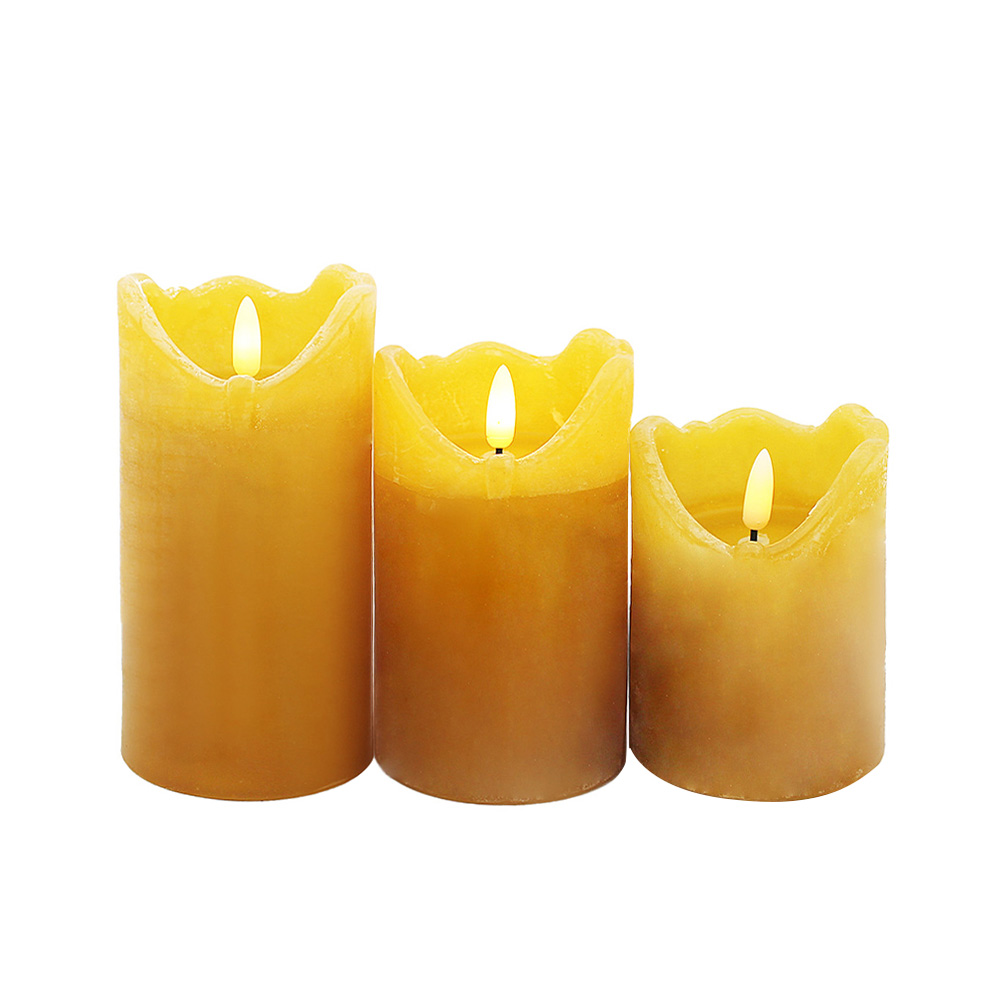
To achieve an indistinguishable visual match to traditional candles, premium production lines insert a hollow plastic internal chassis into a secondary mold where real paraffin or soy wax is injected around the exterior. This process requires precise melt-temperature calibration at exactly 58°C to 62°C to ensure the hot wax bonds smoothly with the plastic core without warping the internal battery housing. This method retains the classic texture, scent-throwing capability, and translucent edge glow of traditional wax while protecting the internal electronic components.
Acrylonitrile Butadiene Styrene and Polycarbonate Composites
For heavy-use commercial environments like outdoor restaurants, cruise ships, and high-traffic hotels, factories utilize high-impact Acrylonitrile Butadiene Styrene (ABS) or UV-stabilized Polycarbonate (PC). These engineering polymers prevent the melting, warping, and scratching that occurs when real wax is exposed to direct sunlight or high ambient heat. By modifying the internal surface texture of the plastic molds, factories can replicate a matte, realistic wax-like finish that resists impact damage during repeated transit and cleaning cycles.
Electronics Integration and Optical Flicker Engineering
The distinction between a low-cost novelty item and a high-fidelity commercial product lies in the electronics assembly department of the factory. The core components consist of custom-engineered printed circuit boards (PCBs) paired with precise optical lenses.
Electromagnetic Moving Wick Mechanisms
High-tier manufacturing facilities implement active mechanical wicks to simulate natural flame movement. This system mounts a lightweight, flame-shaped plastic blade on a delicate pivoting pin inside the candle top. Below the pin, an electromagnetic coil interacts with a micro-magnet embedded in the base of the blade. When the PCB sends a pulse of variable electric current, the coil generates a shifting magnetic field that moves the wick rhythmically. An angled LED then projects light upward onto the moving blade, creating realistic flickering shadows on nearby walls.
Pulse-Width Modulation Algorithm Programming
To minimize mechanical wear and lower production costs on mid-tier lines, factories program custom microcontrollers with complex Pulse-Width Modulation (PWM) algorithms. Rather than physically moving a plastic wick, the static LED is dimming and brightening at random millisecond intervals. By combining a dual-chip LED that blends warm 2700K amber tones with 3000K soft white highlights, the programmed circuit shifts the light intensity and color temperature simultaneously, mimicking the natural behavior of a burning cotton wick.
Comparative Production Dynamics: Flameless Factory vs. Traditional Foundry
Evaluating infrastructure upgrades requires comparing structural parameters, process controls, and yield metrics between an automated electronics-driven flameless factory and a legacy combustion candle foundry.
Operational Paradigm Metrics: Automated Flameless Pillar Candle Factories Versus Legacy Open-Flame Combustion Wineries
| Manufacturing Parameter |
Flameless Pillar Candle Factory |
Traditional Combustion Candle Foundry |
| Primary Assembly Mechanism |
Automated SMT PCB & Injection Molding |
Gravity Melt-Pouring & Wicking Lines |
| Quality Control Acceptance Rate |
> 99.7% (Automated Optical Inspection) |
88% - 92% (High Shrinkage & Cavity Distortion) |
| Product Structural Longevity |
5,000 - 10,000 Hours (LED Duty Rating) |
30 - 80 Hours (Consumed by Combustion) |
| Environmental VOC Emissions |
Zero (Fully Inert Plastic/Solid Wax Polymer) |
Soot, Acrolein, and Carbon Monoxide Byproducts |
| Custom Feature Integration |
Infrared Remote, Timers, and Smart App Control |
None (Manual Ignition/Extinguishment Only) |
The production data highlights why the market is shifting toward automated flameless manufacturing. While traditional pouring foundries face constant inventory losses from wax shrinkage, thermal cracking, and deformation, flameless production relies on solid-state electronics and standardized dimensions. This consistency ensures that every pillar candle matches required tolerances, facilitating predictable product integration and lowering defect rates during bulk retail rollouts.
Step-by-Step Flameless Pillar Candle Assembly Workflow
The creation of a commercial-grade flameless pillar candle requires a continuous, automated workflow that links electronics fabrication with precision structural molding.
- PCB Fabrication and Component SMT Placement: Raw circuit boards feed into automated pick-and-place machines that mount the microcontrollers, resistors, timing chips, and LED diodes. The boards pass through a multi-zone reflow oven to solidify the solder joints.
- In-Circuit Testing and Firmware Flashing: Automated test fixtures apply power to each circuit board, testing the electrical traces for shorts. Concurrently, the factory computer flashes the specific PWM flicker code and remote control timing software onto the microcontroller.
- Injection Molding of the Internal Core Chassis: High-pressure molding machines inject ABS plastic into multi-cavity steel dies to create the core cylinder, battery doors, and internal wick-pivoting columns.
- Wax Overmolding Outer Shell Finishing: For wax-finished lines, the plastic chassis core travels to a secondary rotational mold where refined paraffin wax is injected at 60°C around the core. The molds are rapidly water-cooled to produce a smooth, flawless exterior finish.
- Final Mechanical Integration and Sonic Welding: Assembly technicians or robotic arms slide the completed PCB and electromagnetic wick module into the wax-coated chassis. The bottom battery compartment plate is aligned and sonically welded or screwed into place to seal the entire system.
- Mass Burn-In and Final Packaging Inspection: Every completed candle is placed on a centralized testing rack and powered on for at least 4 continuous hours. Automated camera sensors monitor the racks to verify that flicker rates, brightness levels, and remote sensors operate within specified parameters before final packaging.
Supply Chain Management, Scalability, and Sustainability
Operating a modern flameless pillar candles factory requires managing a multi-tiered supply chain that spans both raw plastics and semiconductor electronics. Unlike traditional candle production, which depends heavily on agricultural soy yields or volatile petroleum refining outputs, flameless manufacturing benefits from more stable component sourcing. Factories minimize their environmental footprint by grinding down and recycling injection-molding scrap plastic back into the initial production loops, keeping material waste near zero.
Furthermore, by designing products that comply with RoHS (Restriction of Hazardous Substances) and CE regulatory directives, export-oriented factories ensure that all circuit boards are free from lead, cadmium, and mercury. This focus on chemical safety simplifies customs clearance for global distributors shipping to strict markets in the European Union and North America. It also aligns product lines with the sustainability mandates of international resort corporations and major retail organizations.





 +86-18067520996
 +86-574-86561907
 +86-574-86561907
 [email protected]



